Bio Ch 14 Review What Is the Chemical Compound of Dna
Nucleic acids are the organic materials present in all organisms in the course of Dna or RNA. These nucleic acids are formed by the combination of nitrogenous bases, sugar molecules and the phosphate groups that are linked by different bonds in a serial of sequences. The DNA construction defines the basic genetic makeup of our torso. In fact, it defines the genetic makeup of most all life on earth.
Table of Contents
- What is DNA?
- Discovery
- Diagram
- DNA Structure
- Chargaff'south Dominion
- Dna Replication
- Function of Dna
- Why Deoxyribonucleic acid is chosen a Polynucleotide Molecule?
Read on to explore Dna meaning, structure, function, Deoxyribonucleic acid discovery and diagram in complete detail.
What is DNA?
"Deoxyribonucleic acid is a grouping of molecules that is responsible for carrying and transmitting the hereditary materials or the genetic instructions from parents to offsprings."
This is likewise true for viruses as most of these entities take either RNA or DNA as their genetic cloth. For instance, some viruses may have RNA equally their genetic material, while others have Deoxyribonucleic acid as the genetic textile. The Human Immunodeficiency Virus (HIV) contains RNA, which is so converted into DNA after attaching itself to the host jail cell.
Apart from beingness responsible for the inheritance of genetic information in all living beings, Deoxyribonucleic acid besides plays a crucial role in the production of proteins. Nuclear Dna is the Deoxyribonucleic acid contained within the nucleus of every jail cell in a eukaryotic organism. It codes for the majority of the organism's genomes while the mitochondrial Dna and plastid Dna handles the rest.
The DNA present in the mitochondria of the prison cell is termed as mitochondrial DNA. It is inherited from the female parent to the kid. In humans, there are approximately xvi,000 base pairs of mitochondrial DNA. Similarly, plastids have their ain DNA and they play an essential role in photosynthesis.
Also Read:Deviation betwixt gene and DNA
Full-Grade of Deoxyribonucleic acid
Dna is known as Deoxyribonucleic Acrid. Itis an organic compound that has a unique molecular construction. It is found in all prokaryotic cells and eukaryotic cells.
Deoxyribonucleic acid Types
There are three different Deoxyribonucleic acid types:
- A-Deoxyribonucleic acid:It is a right-handed double helix similar to the B-Deoxyribonucleic acid form. Dehydrated Deoxyribonucleic acid takes an A form that protects the DNA during farthermost condition such as desiccation. Protein bounden also removes the solvent from Deoxyribonucleic acid and the Dna takes an A form.
- B-Deoxyribonucleic acid:This is the virtually mutual DNA conformation and is a right-handed helix. Bulk of DNA has a B type conformation nether normal physiological conditions.
- Z-DNA:Z-DNA is a left-handed Dna where the double helix winds to the left in a zig-zag pattern. It was discovered by Andres Wang and Alexander Rich. It is found alee of the offset site of a factor and hence, is believed to play some office in gene regulation.
Who Discovered Deoxyribonucleic acid?
DNA was start recognized and identified past the Swiss biologist, Johannes Friedrich Miescher in 1869 during his research on white blood cells.
The double helix construction of a Dna molecule was afterward discovered through the experimental data by James Watson and Francis Crick. Finally, it was proved that DNA is responsible for storing the genetic information in living organisms.
Also Read:Deviation between deoxyribose and ribose
DNA Diagram
The following diagram explains the Deoxyribonucleic acid structure representing the dissimilar parts of the DNA. DNA comprises a carbohydrate-phosphate backbone and the nucleotide bases (guanine, cytosine, adenine and thymine).
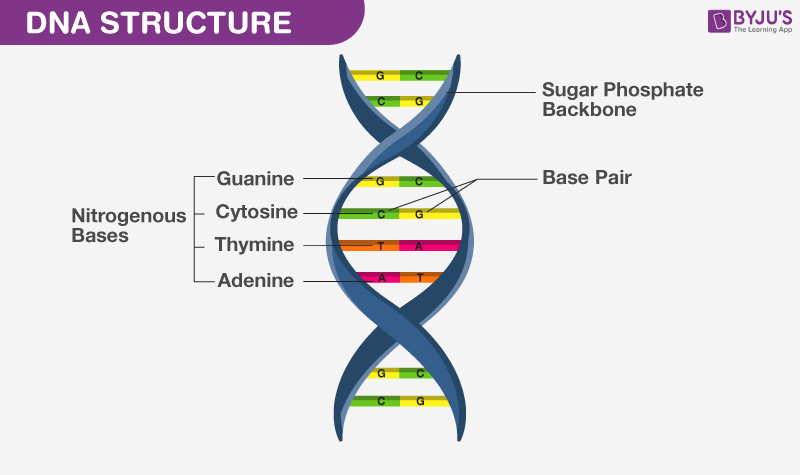
DNA Diagram representing the DNA Structure
Dna Structure
The Dna structure can be thought of similar a twisted ladder. This structure is described as a double-helix, as illustrated in the figure above. It is a nucleic acid, and all nucleic acids are made up of nucleotides. The DNA molecule is composed of units called nucleotides, and each nucleotide is composed of three dissimilar components, such every bit sugar, phosphate groups and nitrogen bases.
The basic building blocks of DNA are nucleotides, which are composed of a sugar group, a phosphate group, and a nitrogen base. The sugar and phosphate groups link the nucleotides together to form each strand of Deoxyribonucleic acid. Adenine (A), Thymine (T), Guanine (G) and Cytosine (C) are 4 types of nitrogen bases.
These 4 Nitrogenous bases pair together in the following way: A withT, and C with G. These base pairs are essential for the Dna'southward double helix structure, which resembles a twisted ladder.
The order of the nitrogenous bases determines the genetic code or the DNA's instructions.

Components of DNA Structure
Among the three components of Deoxyribonucleic acid structure, sugar is the one which forms the backbone of the Deoxyribonucleic acid molecule. It is also chosen deoxyribose. The nitrogenous bases of the contrary strands grade hydrogen bonds, forming a ladder-like construction.
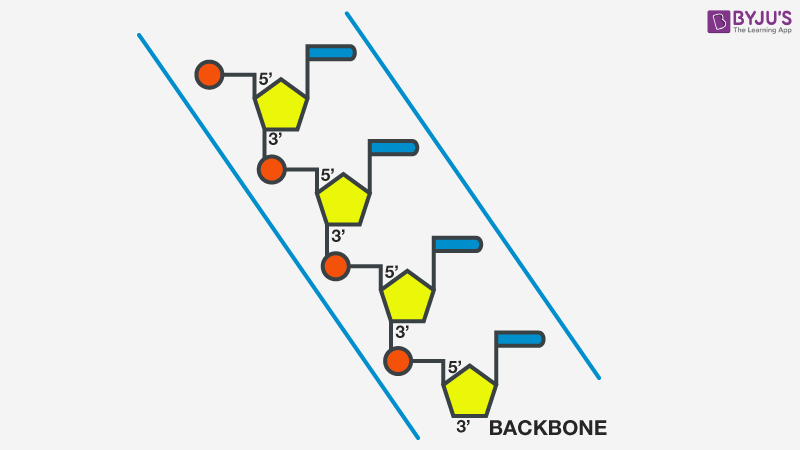
Deoxyribonucleic acid Construction Backbone
The DNA molecule consists of iv nitrogen bases, namely adenine (A), thymine (T), cytosine (C) and Guanine (G) which ultimately forms the structure of a nucleotide. The A and Thousand are purines and the C and T are pyrimidines.
The two strands of DNA run in opposite directions. These strands are held together by the hydrogen bond that is nowadays between the two complementary bases. The strands are helically twisted, where each strand forms a right-handed roll and ten nucleotides make upwardly a unmarried turn.
The pitch of each helix is 3.four nm. Hence, the distance betwixt 2 sequent base of operations pairs (i.e., hydrogen-bonded bases of the opposite strands) is 0.34 nm.

The DNA coils up, forming chromosomes, and each chromosome has a single molecule of DNA in information technology. Overall, human beings take around twenty-three pairs of chromosomes in the nucleus of cells. DNA also plays an essential role in the process of prison cell partitioning.
Also Read: DNA Packaging
Recommended Video:
Chargaff's Rule
Erwin Chargaff, a biochemist, discovered that the number of nitrogenous bases in the DNA was nowadays in equal quantities. The corporeality of A is equal to T, whereas the amount of C is equal to One thousand.
A=T; C=Thousand
In other words, the Deoxyribonucleic acid of whatever jail cell from whatsoever organism should take a 1:1 ratio of purine and pyrimidine bases.
DNA Replication
DNA replication is an important process that occurs during prison cell division. Information technology is also known as semi-conservative replication, during which DNA makes a copy of itself.
Deoxyribonucleic acid replication takes place in three stages :
Footstep ane: Initiation
The replication of DNA begins at a point known as the origin of replication. The two Deoxyribonucleic acid strands are separated by the DNA helicase. This forms the replication fork.
Footstep 2: Elongation
DNA polymerase III reads the nucleotides on the template strand and makes a new strand past adding complementary nucleotides one subsequently the other. For eg., if it reads an Adenine on the template strand, it will add together a Thymine on the complementary strand.
While adding nucleotides to the lagging strand, gaps are formed between the strands. These gaps are known as Okazaki fragments. These gaps or nicks are sealed past ligase.
Footstep iii: Termination
The termination sequence present opposite to the origin of replication terminates the replication process. The TUS protein (terminus utilization substance) binds to terminator sequence and halts Dna polymerase move. It induces termination.
Likewise Read:Deoxyribonucleic acid Replication
Deoxyribonucleic acid Function
DNA is the genetic material which carries all the hereditary information. Genes are the pocket-size segments of DNA, consisting mostly of 250 – 2 1000000 base pairs. A gene code for a polypeptide molecule, where three nitrogenous bases sequence stands for one amino acid.
Polypeptide bondage are further folded in secondary, tertiary and fourth structure to form different proteins. As every organism contains many genes in their DNA, different types of proteins can be formed. Proteins are the main functional and structural molecules in virtually of the organisms. Apart from storing genetic information, DNA is involved in:
- Replication procedure: Transferring the genetic information from one cell to its daughters and from one generation to the next and equal distribution of Dna during the cell division
- Mutations: The changes which occur in the Dna sequences
- Transcription
- Cellular Metabolism
- Deoxyribonucleic acid Fingerprinting
- Gene Therapy
Also Read:r-cistron
Why Deoxyribonucleic acid is chosen a Polynucleotide Molecule?
The DNA is called a polynucleotide considering the DNA molecule is equanimous of nucleotides – deoxyadenylate (A) deoxyguanylate (G) deoxycytidylate (C) and deoxythymidylate (T), which are combined to create long chains called a polynucleotide. As per the Dna structure, the DNA consists of ii bondage of the polynucleotides.
Also Read:Genetic Cloth
For more than detailed information on Deoxyribonucleic acid meaning, diagram, its types, Dna construction and function, or whatever other related topics, explore @ BYJU'Southward Biological science.
Explore more
- Difference between Replication and Transcription
- Dna Cloning
- DNA Fingerprinting
- DNA Every bit Genetic Fabric
- Dna Structure and Polynucleotide
- How is Dna inherited from each parent?
- Do y'all become more DNA from your mother or father?
Frequently Asked Questions
What is the construction of Deoxyribonucleic acid?
DNA is a double helical structure composed of nucleotides. The two helices are joined together past hydrogen bonds. The Deoxyribonucleic acid also bears a sugar-phosphate courage.
What are the 3 different types of Deoxyribonucleic acid?
The 3 dissimilar types of Deoxyribonucleic acid include:
- A-DNA
- B-Dna
- Z-Dna
How is Z-DNA different from other forms of DNA?
Z-DNA is a left-handed double helix. The helix winds to the left in a zig-zag mode. On the contrary, A and B-DNA are right-handed DNA.
What are the functions of DNA?
The functions of Deoxyribonucleic acid include:
- Replication
- Factor expression
- Mutation
- Transcription
- Translation
What type of Dna is institute in humans?
B-DNA is found in humans. It is a correct-handed double-helical structure.
Source: https://byjus.com/biology/dna-structure/
0 Response to "Bio Ch 14 Review What Is the Chemical Compound of Dna"
Mag-post ng isang Komento